31 juillet 2026. Concert à Sisteron
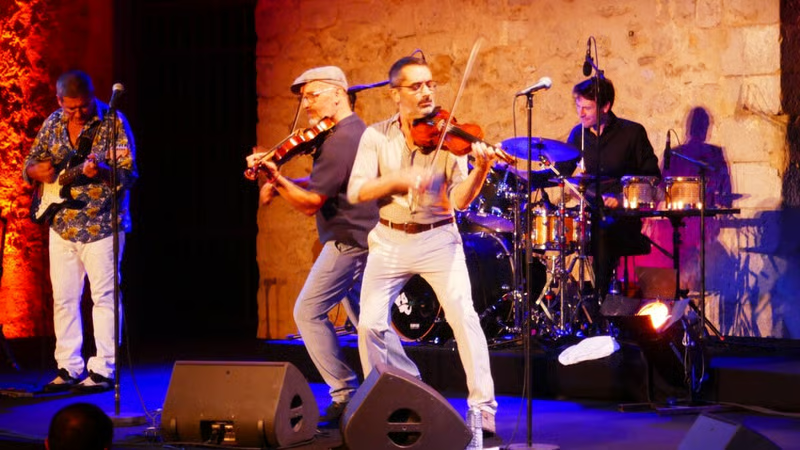
La quatrième soirée des Nuits de la citadelle s’est tenue ce vendredi 31 juillet 2026 au soir au cloître Saint-Dominique, à Sisteron, dans les Alpes-de-Haute-Provence. Le groupe Les Yeux Noirs a fait palpiter la foule au rythme de son jazz, d’airs tsiganes et de l’Est.
Ce vendredi 31 juillet 2026 au soir, on aurait cru voir les pierres danser. Ils étaient six sur scène, et pourtant ils auraient pu être mille, tant l’énergie qu’ils dégageaient était puissante. Une énergie qui s’est démultipliée à mesure que le public donnait des paumes pour galvaniser les musiciens du groupe Les Yeux Noirs…
Les passionnés se sont rassemblés dans le cloître de Saint-Dominique alors que la nuit rafraichissait l’air, resté lourd toute la journée. Au pied du rocher de la Baume, emblématique de la ville de Sisteron (Alpes-de-Haute-Provence), les projecteurs illuminaient progressivement la scène et le clocher effilé de l’église du XIIIe siècle.
Un retour après dix ans d’absence
Dans ce cadre grandiose à l’acoustique étonnante, le spectacle commence. Le groupe entame son répertoire et les musiques s’enchaînent, mêlant compositions originales et mélodies traditionnelles, chansons yiddish et tsiganes, jazz et sonorités actuelles.
Eric et Olivier Slabiak, violonistes et chanteurs nés à Paris dans une famille d’immigrés juifs polonais ont fondé Les Yeux Noirs en 1992. A la fin du deuxième morceau, les artistes s’adressent au public : « On est très émus d’être ici ce soir. Nous avions arrêté Les Yeux Noirs il y a dix ans et nous avons décidé de recommancer ce soir. Ce sera une date dont on se souviendra. « Un retour en avant-première pour le groupe renaissant, qui annoncera bientôt de nouvelles dates…
Archives
The Jakarta Post
Les Yeux Noirs : Singing songs of the gypsies
Lauranne Callet, The Jakarta Post, Jakarta | Fri, 04/20/2012
“Mon fils je vais te chanter une petite chanson,” (My son, I will sing for you a little song) a female voice with a pronounced accent whispered in the speakers, welcoming the audience to the Les Yeux Noirs performance on Wednesday at Gedung Kesenian Jakarta.
No explanation was given about the person behind this voice, but one could bet it was the grandmother of the Slabiak brothers who were “introduced” later in the show.
Les Yeux Noirs’ music particularly fits with this introductory sentence. The French gypsy jazz band — whose style is hard to define in a few words — offered Jakarta an invitation to travel with them along with their tunes made up of family influences, Eastern European flavors and the pleasure of sharing.
The two Slabiak brothers, accompanied by a talented band, have been keeping the musical tradition of their family alive for 20 years already. Their uncles, famous jazz musicians, played with the greats of their time. But to have famous relatives in the music sphere didn’t help them that much as those uncles refused to give them advice in order not to encourage them to have a musical career.
But that didn’t stop the two from becoming experimental musicians and launching Les Yeux Noirs, which means dark eyes, referring to a gypsy song popularized by Django Reinhardt.
The audience was certainly not thinking about the past during the performance that carried along a great majority of the people seated at the concert hall. The duet of violins (Erik and Olivier Slabiak) and the accordion (Dario Ikovik) blended their gypsy jazz tones with strong rock hints from the electric guitar (Frank Anastasio), the bass (Julien Herné) and the drums (Rémi Sanna) for a performance that lasted almost two hours.
Les Yeux Noirs played cover songs as well as original compositions in which they mix musical styles to embrace a large diversity of gypsy cultures from Eastern Europe and Yiddish (Jewish from Eastern Europe) influences.
“The next song is a love song. An impossible love because it’s better. When it happens, you feel it for real,” Eric explained on stage before dashing into the song. The same liveliness was present in their performance of a melancholic Balkan song from Dona, a dynamic musical tale from Belarus. “Lakht der vint in korn/ Lakht er op a tog a gantsn/Un a halbe nacht/Dona, dona, dona, dona…” (The wind is laughing in the wheat/He is laughing all day long/And half of the night/Dona, dona, dona…), the Slabiak brothers sang turning the rough Yiddish language into a powerful melody.
“We listened to David Bowie and a lot of rock ’n’ roll stars when we were younger. It definitely influenced our work,” said Olivier. Eric certainly agreed with his brother’s statement while he was striding along the stage jumping and playing violin to accompany the drums on a furious rhythm. And the audience — mostly French nationals and about a third locals — joyfully followed along, clapping to encourage the musicians.
Those songs had already traveled around Singapore and Indonesia during Les Yeux Noirs’ Asian tour, and the band never gave up the family spirit of their music. On stage, Eric explained in French that they found a tape of their grandmother singing a song they love and so they had the idea to sample her voice to bring her along with them in their performances. Beside him, Eric was doing the English translation and he maliciously shortened it. “We digitalized our grandmother,” he said to the laughing audience before setting off the soft and energetic voice of their forebear.
The performance closed with an incredible violin challenge between the two brothers, who ended up playing on the same instrument. The audience could clearly see that Eric’s speedy movement while dancing lead him to break numerous strings of his violin. But he didn’t pay that any attention.
Les Yeux Noirs has performed at the most prestigious concert venues in France, but when they were asked about their interest in playing abroad, Olivier do not hesitate with his answer. “Cultural exchange and communication are essentials for music to be able to evolve.”
He added that the message in their music was to emphasize that it is possible to live together and to mix cultures.
After the performance, journalists congratulated the band on their terrific performance, which “sounded like Arabic music”. Oliver responded that he was happy that their “music brings people to share emotions even if they don’t come from the same cultural background.”
“Music is a real Esperanto, a universal language,” he added.
Le Monde
Les Yeux Noirs « Tiganeasca »
Le groupe des frères Eric et Olivier Slabiak (violons et voix) formé en 1992, signe son huitième album.
Toujours inventif et virtuose, le groupe fait une nouvelle relecture des répertoires yiddish et tzigane, s’arrêtant notemment sur Dona Dona, célèbre comptine yiddish, qu’a chantée autrefois Joan Baez, ou encore Ashun Daje Mori, un titre de la chanteuse serbe Liljana Buttler, surnommée «la mère de l’âme gitane», morte en avril 2010. Une succession d’univers zébrés d’éclairs de joie ou plombés de sombres mélancolies auxquels participent le guitariste argentin Tomàs Gubitsch, le clarinettiste Yuri Shraibman et Smadj, venu avec ses machines apporter une touche électro. On appréciera la remarquable prise de son de cet enregistrement, réalisé en 2009, à l’église luthérienne de Bon Secours, à Paris.
P. Labesse
Los Angeles Daily News
Les Yeux Noirs, French for « the Black Eyes, » takes its name from the title of a Gypsy tune made famous in the 1930s by Django Reinhardt. That selection gives you an indication of this sextet’s musical pallet – a meld of klezmer, Gypsy music and jazz. If you missed the group in May at the Conga Room, « Live » gives you a sample of that experience. Songs tend to start moodily and slowly, before instruments merge with manic rhythms.
By Philip Zonkel
La Croix
Tiganeasca –
Deux frères d’origine polonaise sont à la tête du groupe Les Yeux Noirs, qui propose une musique empruntant aussi bien à la culture yiddish qu’au chant tsigane.
Paris, quartier du Marais, au début des années 1960. Un chant féminin s’évade d’une boulangerie de la rue Ferdinand-Duval. C’est la voix d’Esther, figure fantasque née en 1900, premier prix de beauté dans sa Pologne natale qu’elle quitte à 20 ans. Elle accueille ses amis musiciens manouches dans l’arrière-boutique, autour du pétrin. Et elle chante. Elle est la « Mémé Esther »
d’Éric et Olivier Slabiak, deux frères aujourd’hui âgés de 41 et 39 ans, âme du groupe Les Yeux Noirs, aux huit albums.
Une grand-mère qui avait «les cheveux mauves er mangeait sa banane avec une fourchette», se souvient Éric, l’aïné. Une grand-mère qui fait partie de leur mythologie familiale : «Elle est morte lorsque nous avions 11 et 9 ans, dit-il encore. Et lorsque nous nous sommes fait connaître avec cette musique yiddish, Mémé Esther revenait toujours dans la conversation. Mais on avait un peu l’impression d’enjoliver l’histoire… »
Dernièrement, la grand-mère a ressurgi, via une bande magnétique retrouvée chez un oncle
« L’enregistrement remontait à 1973, raconte Éric. Mémé Esther était venue à la maison avant
un voyage chez son fils en Israël. Elle voulait pour lui un enregistrement où toute la famille chante. » La précieuse bande se fait oublier…Sa redécouverte, intacte, par les deux frères suscite l’émotion : on y entend Esther chanter, et soudain la mythologie s’anime. « Cette découverte nous a donné envie de ressusciter notre grand-mère », confie Olivier.
Ils « invitent » Mémé Esther dans leur nouveau spectacle et dans leur dernier album Tiganeasca (Zig-Zag). Sa voix y est présente, ainsi que sa photo, avec chapeau et parapluie, sur la pochette. Sur le CD, on retrouve aussi, dans des interprétations magnifiées, des chansons où cultures yiddish et tsigane s’entremêlent : la marque de fabrique du groupe depuis 1992.
J.Y. Dana